
My Musical Career and My Thoughts about Church Music — Alexander Kastalsky
Newly translated by Vladimir Morosan
Translator’s introduction and commentary on Kastalsky’s style:
Alexander Kastalsky (1856–1926) was undoubtedly the seminal figure of his generation of Russian Orthodox church composers, the acclaimed founder of a new style of choral writing—one that employed compositional principles and techniques of part-writing derived fundamentally from the “raw material” of liturgical chant, rather than from Western European theory textbooks. His approach was taken up and developed more broadly by such prominent composers as Alexander Gretchaninoff (1864–1956), Pavel Chesnokov (1877–1944), and Sergei Rachmaninoff (1873–1943), along with a host of others, who collectively formed what came to be known as the “New Direction” (novoye napravleniye) in Russian Orthodox music.
In 1913, at the height of his musical career, as Director of the Moscow Synodal School of Church Singing, Kastalsky was invited to contribute an autobiographical article for the new journal Muzykal’nyi sovremennik[The Musical Contemporary]. Although an English translation of this article appeared in 1925 in the British journal The Musical Quarterly, the centenary of the composer’s death seemed like an appropriate occasion to produce a fresh, new translation, one in which the numerous references to various personages, terms, and events mentioned in the article are annotated and clarified for the modern-day reader. <…>
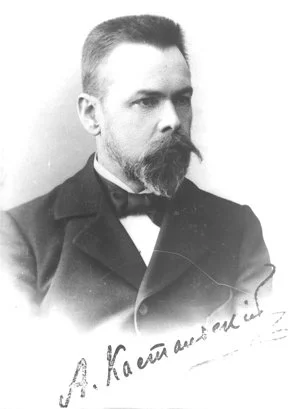
Having joined the Synodal School of Church Singing in 1887 as a teacher of piano, I first became acquainted with the distinctive discipline of working with a church choir; it was directed by Vasily Sergeyevich Orlov, who later became quite famous, and with whom we had been well acquainted since our Conservatory days—it was thanks to him that I was accepted into the “Synodalka,” as the school was sometimes called. Among other things, I was invited to try my hand at harmonizing some traditional chant melodies, but these attempts were deemed unsatisfactory, because at that time the prevailing opinion—which I believe belonged to S. I. Taneyev—held that our church melodies should not be harmonized but rather treated contrapuntally, in the manner of the Western masters of the fifteenth and sixteenth centuries. I naturally had no such technique, although I sometimes tried to apply various contrapuntal tricks to our church chants. In 1891 I was invited to become Orlov’s assistant with the Synodal Choir.
I became a church composer—indeed, even the “founder” of an entire school—quite unexpectedly, both to myself and to others; just as accidentally as I had entered the Conservatory while preparing for a career in agriculture. Once in 1896, while looking through and selecting various pieces with V. S. Orlov for the Synodal Choir’s repertoire, I tried comparing the melody of one “Dostoino” [It is Truly Meet] in a Serbian chant with the original melodies in the Serbian chant obikhod and noticed that the composer had evidently been unable to handle a single one of them properly. Vasily Sergeevich suggested that I harmonize one of these melodies. My harmonization, and indeed the “Dostoino” chant itself, struck me as somewhat ornate and affected—this prompted me to make an arrangement of the “Milost’ mira” [A Mercy of Peace] found in the same Serbian collection in a much simpler manner.
Although these harmonizations of mine were liked by everyone and are still in use in church choirs to this day, I attached not the slightest artistic value to them. But their success encouraged me to take a closer look at the traditional chant melodies. <…>
